Carved by millennia of tidal force and limestone geology, the Blue Cave near Dubrovnik has captivated seafarers, poets, and modern travellers alike. Its ethereal electric-blue glow conceals a story far older and richer than most visitors ever realise.
The Blue Cave — known locally as Modra Špilja — is located on the island of Bisevo, approximately five kilometres off the coast of the island of Vis in the southern Adriatic Sea. While Vis sits roughly 45 kilometres from Split rather than Dubrovnik itself, the cave is commonly marketed and accessed as part of the broader Dalmatian Coast experience, frequently included on speedboat day tours departing from Dubrovnik. The cave's physical formation dates back millions of years, shaped by the relentless erosion of Adriatic seawater acting upon the Dinaric karst limestone that defines this entire coastal region's dramatic and porous geology.
The process that created the cave involved seawater gradually dissolving and eroding the soluble limestone bedrock over vast geological timescales, forming a submerged underwater entrance and a hollow chamber above the waterline. This precise configuration — a low submerged opening combined with a white sandy seabed — is what produces the cave's legendary optical effect. Ancient Illyrian tribes, who inhabited the broader Vis archipelago as early as the fourth century BC, would have navigated these waters and almost certainly encountered the grotto, though no written records document their specific interaction with this remarkable natural formation.
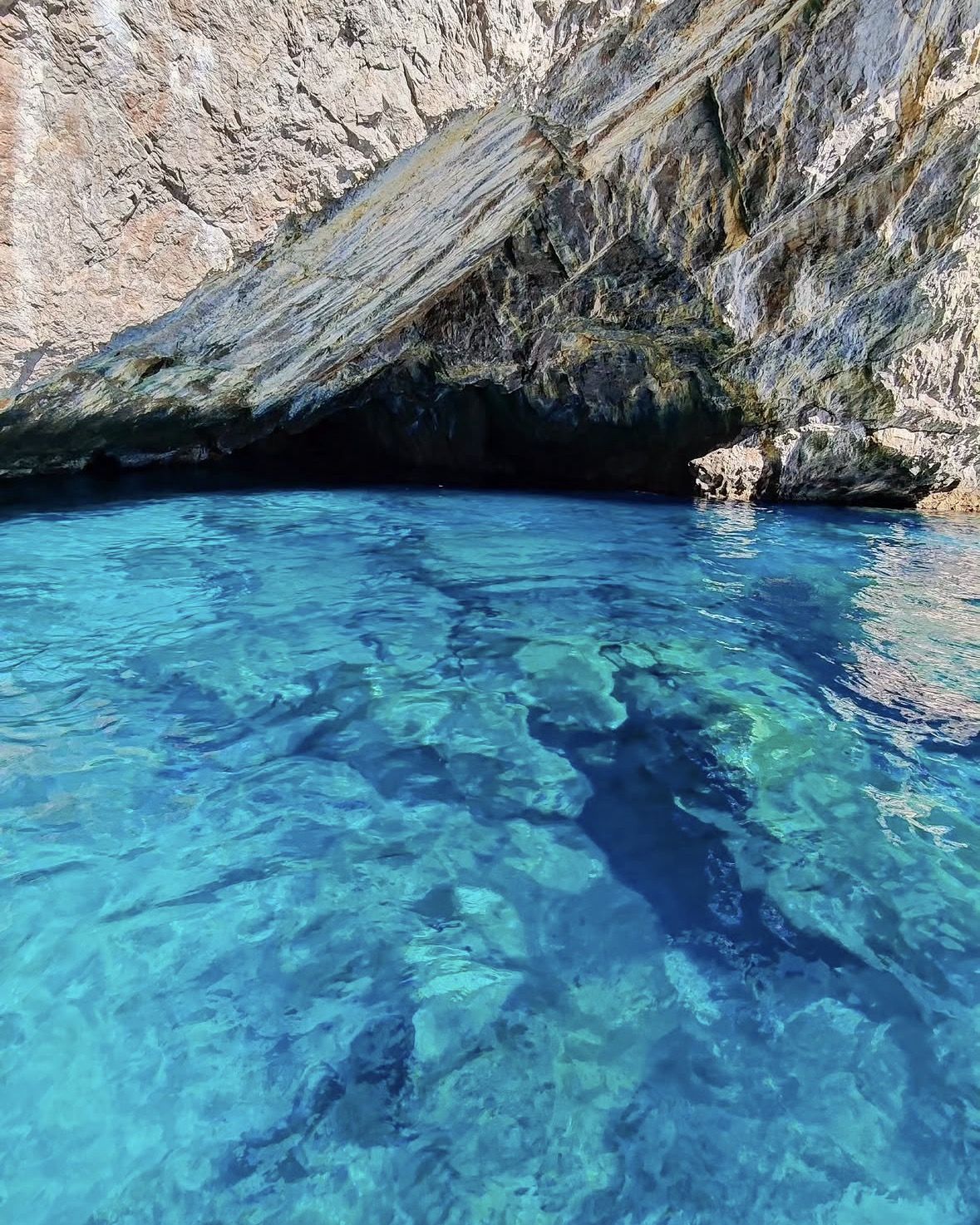
The defining characteristic of the Blue Cave is its extraordinary bioluminescent-like illumination, which is in fact a natural optical phenomenon rather than any biological process. Between approximately 11:00 AM and noon, sunlight penetrates the submerged entrance — roughly 1.5 metres below the water's surface — and refracts upward through the clear Adriatic water, striking the white reflective seabed and casting the entire interior chamber in a vivid, shimmering electric-blue light. The effect transforms swimmers and boat hulls into glowing silver silhouettes, creating a genuinely otherworldly visual experience that has no photographic filter or enhancement in authentic imagery.
Local Dalmatian fishermen had long been aware of the cave's unusual light effects, and oral traditions passed down through generations on Bisevo and Vis describe the grotto as a place of spiritual energy and mystery. Some folkloric accounts suggest fishermen sought shelter inside the cave during storms, emerging to describe the blue radiance as an almost divine phenomenon. In a region deeply shaped by centuries of Venetian, Byzantine, and later Ottoman cultural influence, natural landmarks of such visual drama inevitably became woven into local mythology and identity, serving as navigation reference points and subjects of storytelling across the fishing communities of the central Dalmatian islands.
The formal European discovery and documentation of the Blue Cave is attributed to the Austrian geologist and explorer Baron Eugen von Ransonet-Villez, who visited Bisevo in 1884 and produced detailed written accounts and illustrations of the cave's interior light effects. His reports drew comparisons to the already-famous Blue Grotto of Capri in Italy, which had been rediscovered by Western travellers in 1826. Von Ransonet-Villez's accounts circulated among European scientific and aristocratic circles, sparking the first wave of intentional tourist interest in this remote Adriatic wonder and establishing Bisevo as a destination worthy of dedicated maritime expedition.

Following Baron von Ransonet-Villez's late nineteenth-century documentation, the Blue Cave began attracting a trickle of adventurous European travellers willing to undertake the considerable maritime journey to reach the remote island of Bisevo. In the early twentieth century, the Austro-Hungarian administration of Dalmatia facilitated modest improvements to regional maritime infrastructure, making islands like Vis and Bisevo marginally more accessible. However, the cave remained an exclusive destination for wealthy adventurers and scientists until well after the Second World War, when Yugoslavia's gradual opening of its Adriatic coast to international tourism in the 1960s brought the first significant organised visitor numbers to the island and its famous sea cave.
The establishment of the Socialist Federal Republic of Yugoslavia under Josip Broz Tito introduced a complex chapter for Vis and Bisevo specifically. The island of Vis was designated a closed military zone by the Yugoslav National Army due to its strategic Adriatic position, and foreign tourists were prohibited from visiting until 1989 — the year the military restrictions were finally lifted. This decades-long closure paradoxically preserved the natural environment around Bisevo and the Blue Cave in exceptional condition, shielding the area from the mass-tourism development that transformed other Dalmatian destinations during Yugoslavia's mid-century tourist boom.
After Croatian independence in 1991 and the subsequent end of the Homeland War, the Blue Cave rapidly gained international recognition as one of Europe's most spectacular natural wonders. Travel publications, documentary filmmakers, and early internet travel forums amplified awareness of the cave throughout the 1990s and 2000s. The Croatian National Tourist Board embraced the Blue Cave as a flagship marketing asset, and it was increasingly bundled into multi-island speedboat excursions departing from Split, Hvar, and — notably for the tour industry — from Dubrovnik, despite the considerable distance involved in those full-day journeys.

Today the Blue Cave on Bisevo is one of the most photographed and sought-after natural attractions along the entire Adriatic coast. Entry to the cave is strictly regulated by the Croatian authorities and managed through licensed local boat operators based on Bisevo, who ferry visitors in small wooden boats through the low submerged entrance — an experience that requires passengers to lie flat as the boat glides beneath the rock. Daily visitor numbers are capped during peak season to protect the delicate cave environment, and entry is only possible when sea conditions permit safe navigation through the underwater passage, typically from May through October.
Whether you approach by speedboat from Split, by catamaran from Hvar, or as part of one of the ambitious full-day Dubrovnik island-hopping tours that cover the Blue Cave alongside Hvar Town and the Pakleni Islands, the moment the boat enters that chamber and the world turns blue is universally described as one of travel's most genuinely unforgettable sensory experiences. More than a century after its formal European discovery, the Blue Cave continues to earn its reputation as an unmissable Adriatic gem — and the only way to truly understand why is to see that luminous blue world for yourself.
Ready to Experience It Yourself?
Don't leave the Adriatic without witnessing the legendary blue glow that has captivated travellers since the nineteenth century. Our handpicked Blue Cave tours from Dubrovnik include expert guides, comfortable speedboats, and seamless entry arrangements so you can focus entirely on the magic. Secure your spot today — places fill fast during peak season and this is one experience you will never want to have missed.
Book Your Tour Now